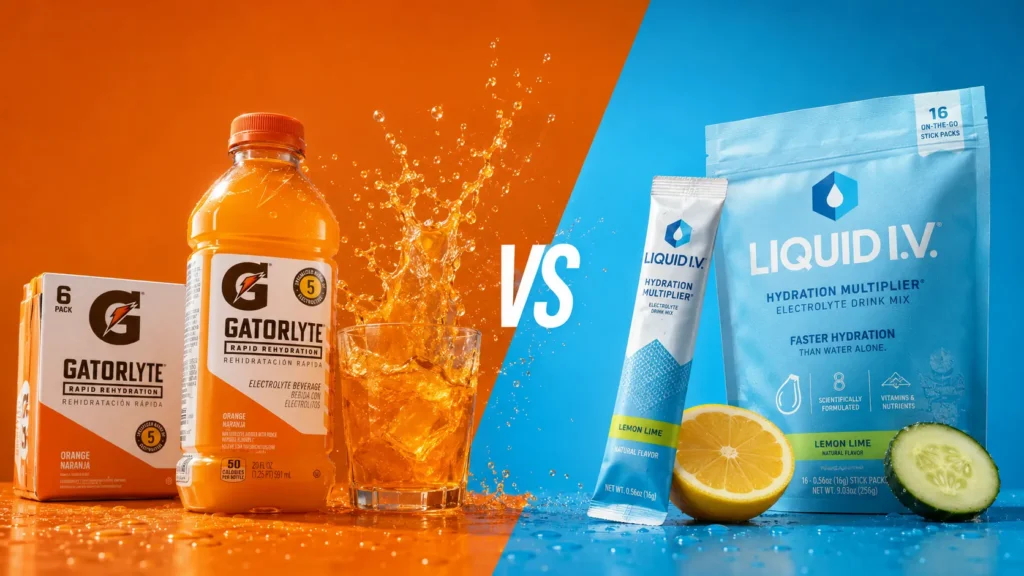
Gatorlyte vs Liquid IV requires an exact product match because both names cover multiple formats and formulas. The ready-to-drink Gatorlyte reviewed here provides five listed electrolytes and some sugar, while Liquid I.V. Hydration Multiplier is a powder with sodium, potassium, vitamins, and either sugar or alternative sweeteners depending on the version. This guide compares equivalent labels and explains which formula may better match exercise, illness-related fluid loss, convenience, or dietary preferences.
Table of Contents
Neither is perfect for everyone. And two questions keep coming up alongside the comparison: is gatorlyte bad for your kidneys and is liquid iv bad for your kidneys? This article answers all of it honestly – ingredient by ingredient, use case by use case – so you can make a properly informed choice between these two products.
What Each Product Actually Is
Gatorlyte
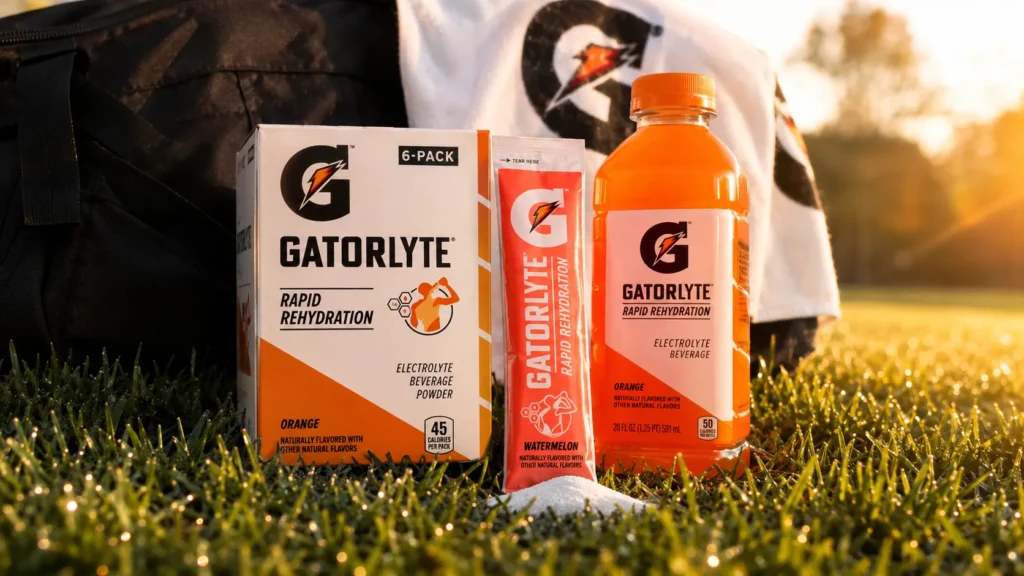
Gatorlyte launched in 2021 under Gatorade‘s brand, developed by the Gatorade Sports Science Institute – one of the most credible sports nutrition research bodies in the industry. The product was built to address a gap in the sports drink market: a formula with significantly more electrolytes than standard Gatorade, far less sugar than the original, and no artificial sweeteners or dyes. Gatorlyte is available as a ready-to-drink (RTD) 20 oz bottle and as powder packets called Gatorlytes – the powder version carries no added sugar at all, making it the cleaner of the two formats.
Each RTD bottle delivers five electrolytes: 490 mg sodium, 350-400 mg potassium, 1,040 mg chloride, 105 mg magnesium, and 120 mg calcium. The sugar content sits at 12 grams per bottle – roughly one-quarter of what you find in a standard Gatorade Thirst Quencher. Importantly, Gatorlyte is formulated to be isotonic, meaning its osmolality sits in the 270-300 mOsm/L range that clinical research consistently identifies as the optimal window for rapid fluid delivery into the bloodstream.
Liquid IV
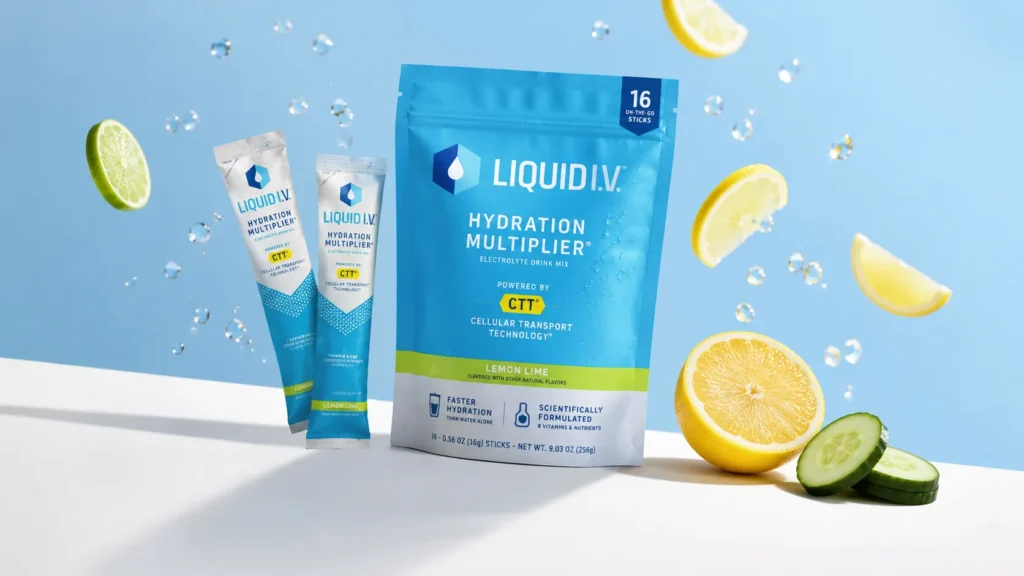
Founded in 2012 by Dr. Eduardo Dolhun and later acquired by Unilever in 2020, Liquid IV built its identity around Cellular Transport Technology (CTT) – a formula that pairs sodium, glucose, and potassium in ratios that activate the sodium-glucose cotransport pathway in the small intestine. This mechanism, backed by WHO oral rehydration solution science, allows fluids to absorb into the bloodstream faster than water alone.
Each original Liquid IV packet delivers 500 mg sodium, 370 mg potassium, 11 grams of sugar, 45 calories, and a set of B vitamins (B3, B5, B6, B12) plus 66 mg of vitamin C. The sugar-free version replaces the glucose with allulose and stevia, retaining the electrolytes and vitamins without the calorie load. Liquid IV is a powder-only product with over 20 available flavors and wide retail availability.
Head-to-Head Comparison Table
| Feature | Gatorlyte (RTD) | Liquid IV (Original) |
| Sodium | 490 mg | 500 mg |
| Potassium | 350-400 mg | 370 mg |
| Chloride | 1,040 mg | Not listed |
| Magnesium | 105 mg | 0 mg |
| Calcium | 120 mg | 0 mg |
| Total Electrolytes | 5 | 2 core (+ vitamins) |
| Sugar | 12 g (RTD) | 11 g |
| Calories | 80 (RTD) | 45 |
| B Vitamins | No | Yes (B3,B5,B6,B12) |
| Vitamin C | No | Yes (66 mg) |
| Osmolality | Isotonic (~270-300) | Hypertonic |
| Format | RTD bottle + powder | Powder only |
| Price/Serving | $1-3 (format varies) | ~$1.47-1.87 |
| Best For | Athletes, post-workout | General hydration, travel, illness |
Electrolyte Comparison: Where Gatorlyte Goes Broader
The most significant structural difference in liquid iv vs gatorlyte is the electrolyte count. Gatorlyte contains five electrolytes. Liquid IV contains two core electrolytes – sodium and potassium – with vitamins filling the remaining label space.
Chloride is the standout. At 1,040 mg per Gatorlyte serving, it’s the most abundant electrolyte in the formula by weight. Chloride works directly alongside sodium to maintain fluid balance, blood volume, and stomach acid production. Cleveland Clinic notes that sodium and chloride together are especially effective at driving hydration. Liquid IV does not list chloride as a separate ingredient – meaning Gatorlyte delivers roughly 50% more hydration-active electrolytes per serving by this measure, according to BodybuildingMealPlan’s nutrition analysis.
Magnesium and calcium are the other two gaps. Gatorlyte provides 105 mg of magnesium and 120 mg of calcium. Liquid IV provides zero of either. For someone dealing with muscle cramps, post-workout recovery, or simply trying to cover more mineral bases in one drink, Gatorlyte’s broader spectrum makes a real difference. Treeline Review’s 2026 electrolyte powder roundup confirmed that a truly complete electrolyte product should include all five core minerals – sodium, chloride, potassium, calcium, and magnesium. Gatorlyte meets that standard. Liquid IV doesn’t.
On sodium specifically, both products are nearly identical. Gatorlyte carries 490 mg and Liquid IV carries 500 mg per serving – a 10 mg difference that’s nutritionally irrelevant. Both sit at roughly 21% of the FDA’s 2,300 mg daily value. This is a category where neither product has a clear edge.
Sugar and Absorption: Two Different Mechanisms
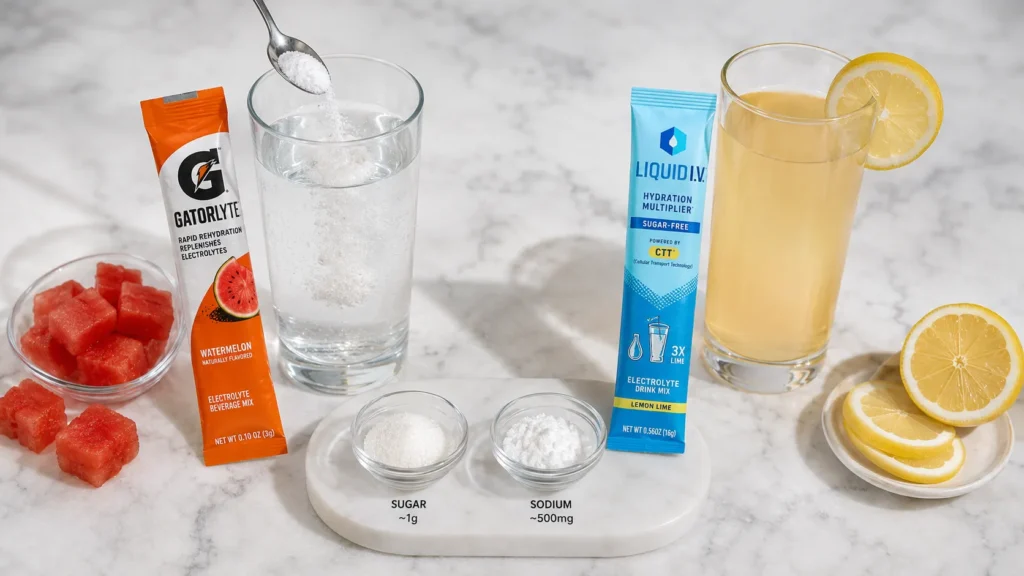
Both Gatorlyte vs Liquid IV use sugar as a functional ingredient, not just a flavoring tool. The sugar content is strikingly similar – 12 grams in a Gatorlyte RTD bottle and 11 grams in a standard Liquid IV packet. But the way each product uses it differs.
Gatorlyte’s sugar supports its isotonic formula. The drink is calibrated to an osmolality of 270-300 mOsm/L – the same range that clinical research identifies as optimal for rapid fluid delivery. Vitalyte’s detailed 2025 electrolyte comparison, which tested osmolality across 10+ products, confirmed that Gatorlyte is one of very few commercial products that truly hits the isotonic target. This matters in athletic contexts because isotonic drinks clear the stomach faster and deliver electrolytes more efficiently during exercise than hypertonic alternatives.
Liquid IV’s sugar serves a different function. It activates the sodium-glucose cotransport mechanism – a rapid absorption pathway that pulls water and electrolytes through the intestinal wall faster than osmosis alone. The WHO endorsed this mechanism in 1978 as part of its Oral Rehydration Solution framework, and Liquid IV meets those ORS standards. Liquid IV’s formula is technically hypertonic, meaning its osmolality sits above 300 mOsm/L. According to Vitalyte’s analysis, hypertonic drinks absorb more slowly during hard exercise compared to isotonic alternatives – though the CTT mechanism compensates through its active transport pathway.
Liquid IV’s sugar-free version removes the glucose and replaces it with allulose and stevia. The allulose sweetener is notable – it’s a rare sugar that tastes close to regular sugar, carries virtually zero glycemic impact, and doesn’t trigger insulin. For people avoiding glucose for blood sugar, keto, or fasting reasons, the sugar-free Liquid IV is a genuinely viable alternative. Gatorlyte’s powder format (Gatorlytes) is their equivalent clean option – no added sugar, just the five electrolytes in pure powder form.
Vitamins: Liquid IV Adds Wellness; Gatorlyte Stays Focused
Liquid IV includes B vitamins (B3, B5, B6, B12) and 66 mg of vitamin C in every packet. These are genuine additions – B vitamins support energy metabolism, and vitamin C supports immune function and acts as an antioxidant. Multiple reviewers note these vitamins work more as a wellness supplement layer than a direct hydration tool, but they’re real ingredients with established health relevance.
Gatorlyte includes no vitamins. The Gatorade Sports Science Institute’s design philosophy keeps the formula strictly focused on electrolyte replacement – nothing in the bottle serves a purpose other than replacing what sweat removes. Whether this is a limitation or a feature depends entirely on your view. If your diet or supplement stack already covers B vitamins and vitamin C, Liquid IV’s additions are redundant. If you want one product to cover both hydration and a light micronutrient top-up – particularly when traveling or sick – Liquid IV’s formula earns its place.
One point worth knowing: Liquid IV’s vitamin C is ascorbic acid, which metabolizes to oxalate in the body. For people with a history of kidney stones – particularly calcium oxalate stones – this is worth flagging. Our full article on is Liquid IV bad for kidneys covers this connection in detail for anyone with specific kidney stone concerns.
Is Gatorlyte Bad for Your Kidneys?
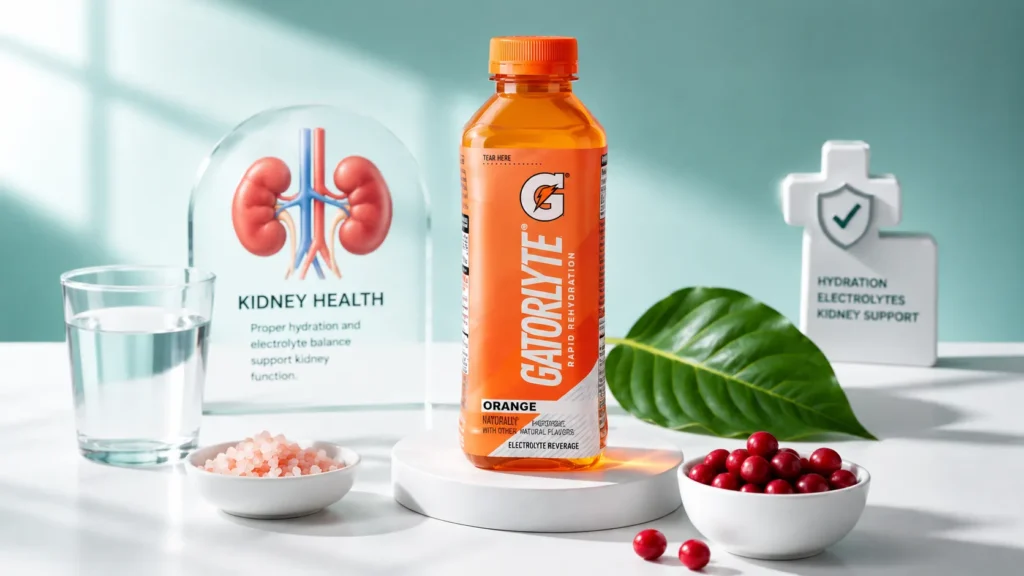
Is gatorlyte bad for your kidneys is one of the most commonly searched questions alongside this product – and the honest answer is no, for people with healthy kidneys. Gatorlyte’s 490 mg of sodium per serving sits at 21% of the FDA daily value, which healthy kidneys handle efficiently through standard filtration and excretion. There’s nothing in Gatorlyte’s five-electrolyte formula that presents a kidney risk for adults with normal kidney function.
The nuance enters for specific groups. Gatorlyte’s 350-400 mg of potassium per serving is relevant for people with chronic kidney disease (CKD). CKD patients – especially in stages 3 through 5 – have reduced ability to excrete potassium, which can allow it to accumulate to dangerous levels (hyperkalemia). For CKD patients, both the potassium and sodium in Gatorlyte require medical oversight before regular use. The same principle applies to people with congestive heart failure, where sodium retention is already a clinical concern.
For active, healthy adults, is gatorlyte bad for your kidneys gets a clear no. The formula is designed to replace what exercise depletes – and at 490 mg of sodium, it falls well below the sodium levels of high-intensity electrolyte products like LMNT (1,000 mg). The kidneys manage this load comfortably in normal circumstances.
Is Liquid IV Bad for Your Kidneys?
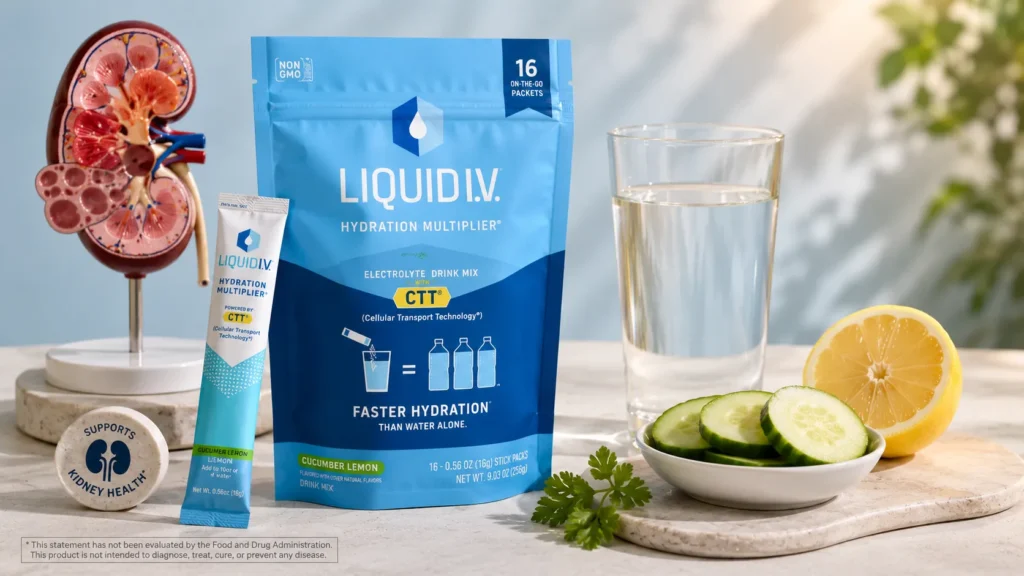
Is liquid iv bad for your kidneys draws the same answer for healthy people: no, it isn’t. One standard Liquid IV packet per day, mixed in adequate water, doesn’t pose a kidney risk for people with normal kidney function. The 500 mg sodium is well within manageable range, and the kidneys excrete what the body doesn’t need.
The kidney stone consideration is the most clinically relevant nuance for Liquid IV specifically. Three ingredients in Liquid IV have been flagged by renal dietitians as potentially concerning for stone-prone individuals: the 500 mg sodium (which increases urinary calcium excretion), the 11 grams of sugar in the original (which raises uric acid production), and the vitamin C from ascorbic acid (which converts to oxalate – the primary compound in calcium oxalate stones). For people without a history of kidney stones, these amounts are not a meaningful risk. For people with prior stones, the combination warrants a conversation with a nephrologist before daily use.
For CKD patients, is liquid iv bad for your kidneys depends on disease stage. The potassium content (370 mg per packet) and sodium content require the same caution as any potassium-containing supplement in advanced CKD. For healthy adults: is liquid iv bad for your kidneys is a no. For people managing kidney conditions – use either product only with medical guidance.
Taste and Format: Real Differences in Daily Use
Gatorlyte’s RTD bottles taste functional and mineral-forward – noticeably less sweet than regular Gatorade, with a mild salty quality that reflects the high chloride content. Most reviewers describe it as refreshing rather than cloying. Flavor options include Cherry Lime, Orange, Strawberry Lemonade, and Watermelon. The powder format (Gatorlytes) tastes lighter and dissolves cleanly into 16-20 oz of water. No artificial colors or sweeteners appear in either Gatorlyte format.
Liquid IV leans sweeter. The original formula with 11 grams of sugar tastes closer to a fruit drink than a mineral supplement, which many users prefer for palatability and consistent daily consumption. With over 20 flavors and widely available stick packs, Liquid IV wins on taste variety and convenience for on-the-go use. The sugar-free version with allulose is notably well-received – most testers describe it as tasting closer to the original than stevia-only alternatives typically do.
On format, Gatorlyte’s RTD bottle wins on immediate convenience – grab and go, no mixing required. Liquid IV’s powder format wins on portability for travel, gym bags, and keeping packets in a desk drawer. If you regularly need hydration on the move without access to water for mixing, Gatorlyte’s bottle edges ahead.
Price Per Serving: Closer Than You Think
Pricing in liquid iv vs gatorlyte depends on which format you compare.
- Gatorlyte RTD 20 oz bottle: $2.00-3.00 per bottle at most retailers
- Gatorlyte powder (Gatorlytes) packets: approximately $1.00 per serving
- Liquid IV original 30ct box: approximately $1.47-1.50 per packet on Amazon
- Liquid IV sugar-free: approximately $1.87 per packet
The Gatorlyte powder format is meaningfully cheaper than both Liquid IV versions. The RTD bottle is more expensive – but it’s pre-mixed and immediately drinkable, which carries its own convenience value. For regular daily use where you control the preparation, Gatorlyte powder is the most cost-effective option in this head-to-head. For someone grabbing a drink mid-workout from a convenience store, Gatorlyte’s RTD bottle is widely available at the same locations you’d find regular Gatorade.
Liquid IV has wider powder format availability – Costco, Target, Walmart, Amazon, and many grocery chains stock it consistently. Gatorlyte’s distribution is growing but still more limited than Liquid IV in the powder form specifically.
Who Should Choose Which
Choose Gatorlyte if you:
- Need rapid rehydration after intense workouts or heavy sweating
- Want five electrolytes – including magnesium, calcium, and chloride – in one product
- Prefer an isotonic formula that clears the stomach efficiently during exercise
- Want an RTD format you can grab pre-mixed at a store
- Are already supplementing B vitamins and don’t need them in your hydration drink
- Want a sports science-backed formula with institutional credibility from the Gatorade Sports Science Institute
Choose Liquid IV if you:
- Travel frequently and want ultra-portable powder packets for anywhere hydration
- Are recovering from illness, hangover, or significant dehydration where rapid absorption is the priority
- Want B vitamins and vitamin C included in your hydration routine
- Prefer a wide variety of flavors with a sweeter, fruitier taste profile
- Use the sugar-free version and want a zero-calorie option with the CTT absorption benefit
- Do moderate exercise or daily hydration maintenance rather than elite athletic training
If you’ve been comparing these two products alongside LMNT’s higher-sodium formula, our LMNT vs Liquid IV breakdown covers how both stack up against that third option. And if you’re exploring the full range of zero-sugar options, our Ultima vs LMNT comparison covers the low-sodium end of the market in detail.
Final Verdict: Liquid IV vs Gatorlyte Which Is Better?
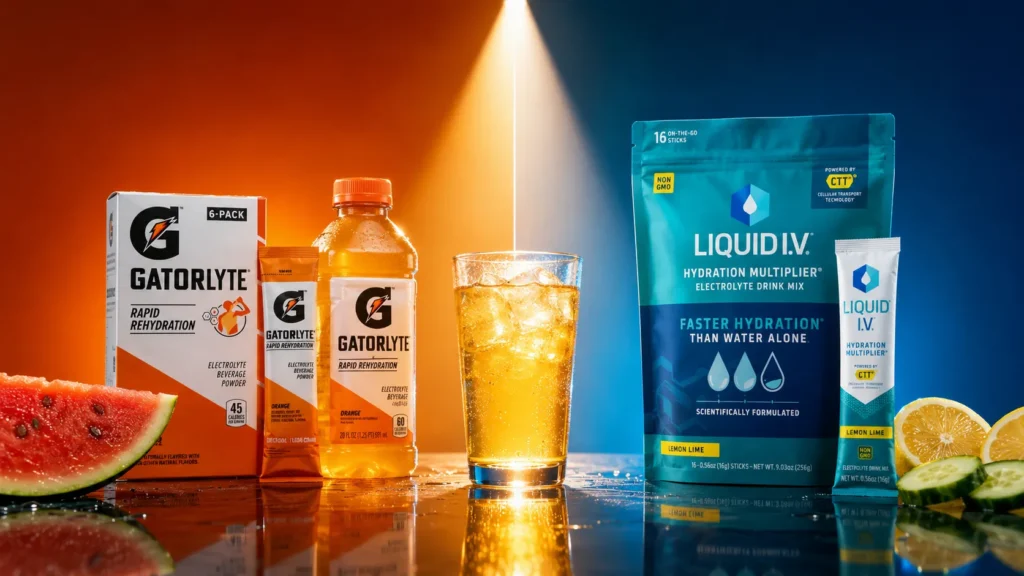
Liquid iv vs gatorlyte which is better genuinely depends on what you’re optimizing for.
If you’re an athlete or regular exerciser who sweats meaningfully – Gatorlyte wins. The five-electrolyte formula, isotonic osmolality, and full spectrum of sodium, potassium, chloride, magnesium, and calcium make it a more complete sweat-replacement product. The sports science behind it is credible and the formula shows it.
If you’re looking for a portable hydration boost for travel, illness recovery, or general daily use with added wellness ingredients – Liquid IV is the stronger choice. The CTT absorption mechanism works, the vitamin additions are real, and the flavor variety makes it genuinely easy to drink consistently.
And on the kidney question: neither product is bad for healthy kidneys when used appropriately. Is gatorlyte bad for your kidneys? No – for healthy adults. Is liquid iv bad for your kidneys? Also no – with the specific caveats around kidney stones and potassium for CKD patients that apply to both products and any electrolyte supplement.
Frequently Asked Questions (FAQ)
The most common questions about Gatorlyte and Liquid IV – answered directly.
Q1. What is the main difference between Gatorlyte vs Liquid IV?
The primary difference in Gatorlyte vs Liquid IV is electrolyte breadth. Gatorlyte provides five electrolytes – sodium, potassium, chloride, magnesium, and calcium – backed by Gatorade Sports Science Institute research. Liquid IV provides two core electrolytes (sodium and potassium) but adds B vitamins and vitamin C. Gatorlyte is isotonic; Liquid IV is hypertonic. Both contain roughly 11-12 grams of sugar in their standard versions.
Q2. Is Gatorlyte bad for your kidneys?
Is gatorlyte bad for your kidneys for healthy adults? No. The 490 mg of sodium and 350-400 mg of potassium per serving fall well within what healthy kidneys filter and excrete efficiently. For people with CKD stage 3-5, the potassium content requires medical guidance before regular use. For healthy, active people – Gatorlyte poses no kidney risk at normal consumption levels.
Q3. Is Liquid IV bad for your kidneys?
Is liquid iv bad for your kidneys for healthy adults? No. One packet per day in adequate water does not strain healthy kidneys. The most relevant kidney concern is for people with a history of kidney stones – three ingredients in Liquid IV (sodium, sugar, and vitamin C as ascorbic acid) can contribute to stone-forming compounds in susceptible individuals. CKD patients need medical clearance before regular use of either product.
Q4. Which has more electrolytes – Gatorlyte or Liquid IV?
Gatorlyte has significantly more electrolytes. It delivers five – sodium, potassium, chloride, magnesium, and calcium – per serving. Liquid IV delivers two primary electrolytes (sodium and potassium). In terms of total mineral content, Gatorlyte carries roughly 50% more hydration-active electrolytes per serving than Liquid IV, primarily due to its 1,040 mg of chloride and inclusion of magnesium and calcium.
Q5. Liquid IV vs Gatorlyte which is better for exercise?
For intense exercise and heavy sweating, Gatorlyte is the stronger option. Its isotonic formulation (270-300 mOsm/L) absorbs efficiently during hard efforts, and its five-electrolyte blend replaces more of what sweat actually removes. For moderate exercise or general hydration support, liquid iv vs gatorlyte is much closer, and Liquid IV’s CTT mechanism works well for everyday rehydration.
This article contains affiliate links. If you purchase through our links, we may earn a commission at no extra cost to you. We only recommend products we genuinely believe in. Read our Affiliate Disclaimer for full details.