
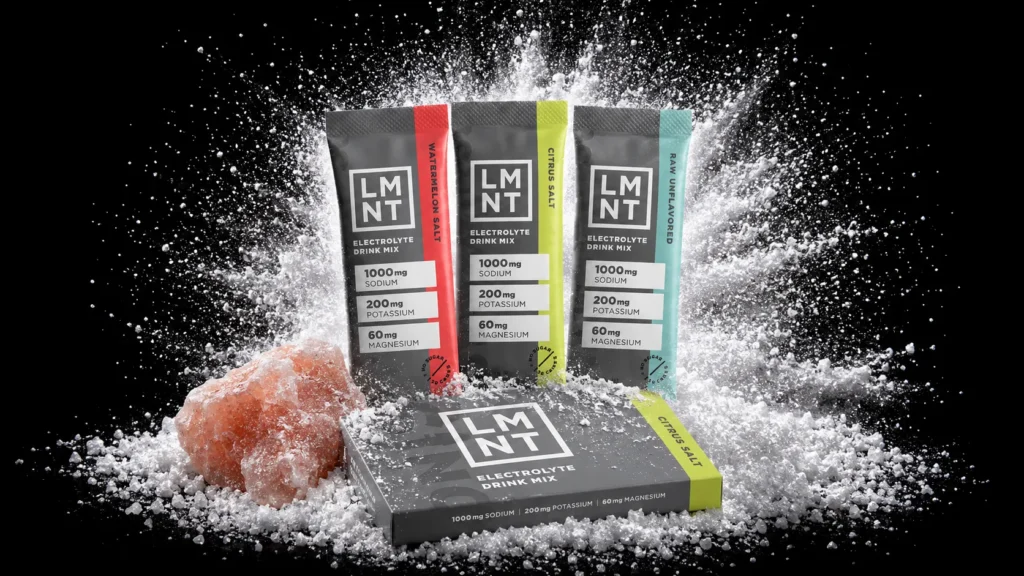
How much sodium is in LMNT? A standard LMNT stick lists 1,000 mg of sodium, which is about 43% of the FDA Daily Value of 2,300 mg. The packet also contains potassium and magnesium, with calories varying between Raw Unflavored and flavored products. That sodium dose may be useful for substantial sweat loss, but it can be unnecessary for people who are sedentary, eat a sodium-rich diet, or have been advised to restrict sodium.
Table of Contents
There’s a real rationale behind it – one rooted in sweat science, dietary research, and the specific needs of active and low-carb lifestyles. This guide covers everything: the exact sodium content, the type of sodium used, how it compares to daily targets, how much potassium is in LMNT, and whether the formula makes sense for your specific situation.
The Exact Nutritional Breakdown of One LMNT Packet
Before digging into the why, here are the confirmed numbers per single LMNT stick pack, sourced directly from LMNT’s official ingredients page and verified by multiple registered dietitian reviews:
- Sodium: 1,000 mg (43% of the FDA daily value)
- Potassium: 200 mg (4% of the FDA daily value)
- Magnesium: 60 mg (15% of the FDA daily value)
- Calories: 0 (Raw Unflavored) to 10 (flavored versions)
- Total Carbohydrates: 0–1 g
- Sugar: 0 g
That’s the entire formula. No added vitamins, no glucose, no artificial colors, no preservatives. LMNT Zero Sugar Electrolytes is the full product description on the label – and those words are accurate. Flavored versions use stevia leaf extract for taste. The Raw Unflavored version contains only the three mineral compounds and nothing else.
Understanding how much sodium in LMNT also requires knowing that 1,000 mg equals exactly 1 gram. LMNT’s science team describes this as roughly one-quarter of what they consider the optimal daily sodium range – which they set at 4–6 grams based on published research.
What Kind of Sodium Is in LMNT?
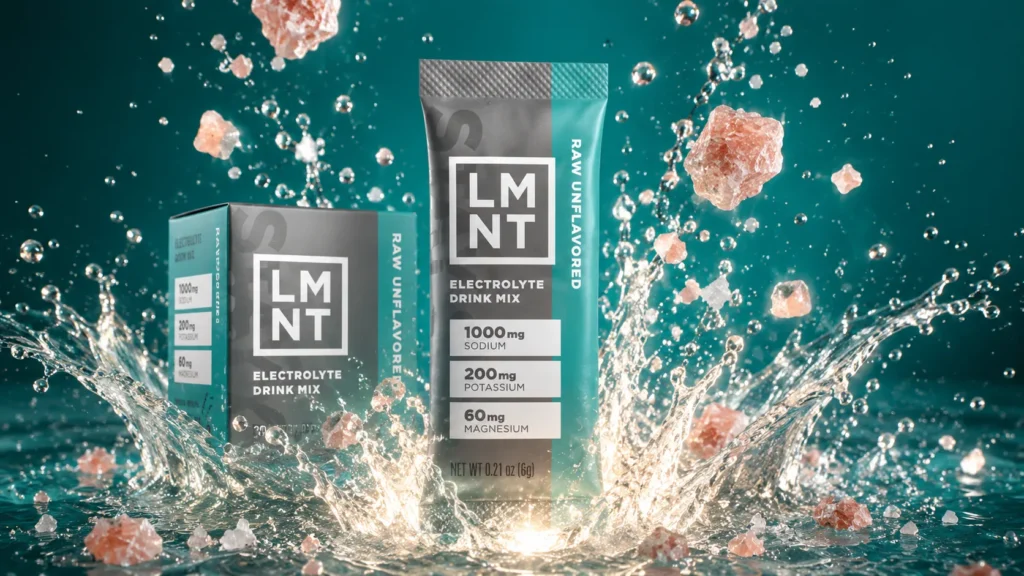
What kind of sodium is in LMNT? The primary sodium source is sodium chloride – the chemical name for table salt. According to LMNT’s official ingredient listing, the first ingredient in every flavored LMNT variety is listed simply as “Salt (Sodium Chloride).” The product also contains potassium chloride, which contributes chloride as a secondary anion – but the dominant sodium form is straightforward sodium chloride.
This matters for a few reasons. Sodium chloride is the most bioavailable form of sodium for electrolyte replacement. It’s what your body loses in sweat in the highest concentrations, and it’s what your kidneys and nerve cells use directly. Some competing products use sodium citrate – the form found in Liquid IV, for example – which is absorbed differently and carries a slightly milder taste. What kind of sodium is in LMNT is therefore a functionally important question: it’s chloride-based, which is specifically what sweat replaces.
LMNT’s science blog also confirms that their formula contains chloride in two forms – from sodium chloride and from potassium chloride – noting that chloride performs similar physiological functions to sodium and is almost always bound to it in nature. What kind of sodium is in LMNT is specifically the most direct, naturally occurring form of dietary salt – not a citrate, bicarbonate, or buffered compound.
How Much Sodium in LMNT vs What the FDA Recommends
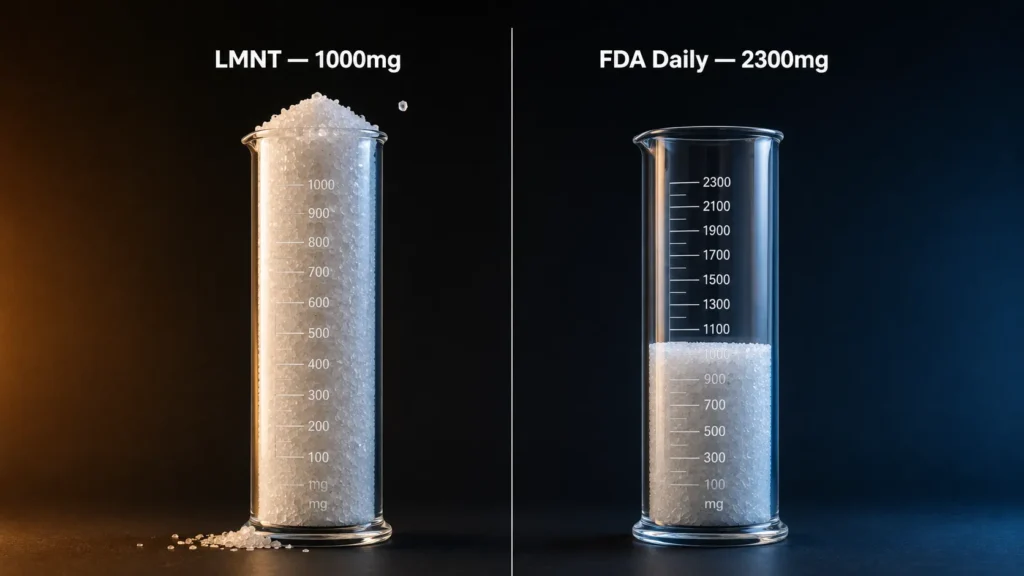
Here’s where the context matters most. The FDA recommends keeping daily sodium intake below 2,300 mg for the general population. The American Heart Association recommends 1,500 mg per day for people with cardiovascular concerns. On those benchmarks, one LMNT packet covers 43% of the standard daily limit before you’ve eaten a single bite of food.
LMNT, however, doesn’t align their formula with the FDA target – and they’re transparent about why. Their co-founder Robb Wolf, a research biochemist, and their science team point to a 2011 study published in JAMA (the Journal of the American Medical Association) that found a daily sodium intake of 4–6 grams was associated with the lowest risk of heart attack and stroke. Both below and above that range showed worse outcomes – what researchers call a J-curve relationship. On that basis, LMNT sets its recommended daily target at 4–6 grams of sodium, meaning one packet contributes one-quarter to one-sixth of that goal.
The scientific debate between the FDA’s 2,300 mg ceiling and the JAMA study’s 4–6 gram sweet spot is genuinely unresolved. What is clear: how much sodium in LMNT per packet – 1,000 mg – is designed to supplement, not saturate, a day’s intake. It works best as part of a broader sodium strategy, not as a standalone daily sodium ceiling.
How Much Potassium in LMNT?
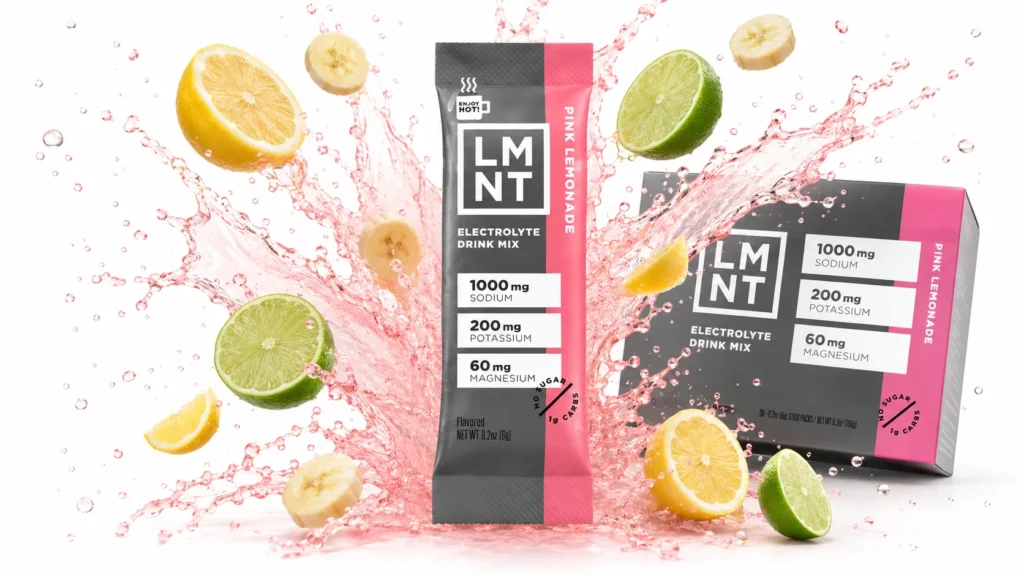
How much potassium in LMNT? Each LMNT stick pack contains 200 mg of potassium – sourced from potassium chloride. That represents 4% of the FDA daily value, which is set at 4,700 mg per day. On paper, 200 mg sounds modest. But LMNT’s design is intentional here.
The sodium-to-potassium ratio in LMNT is 5:1 – five parts sodium to one part potassium. This mirrors the ratio of the sodium-potassium pump, a critical protein in every cell membrane in the body. This pump continuously moves three sodium ions out of the cell for every two potassium ions it pulls in, maintaining the electrical gradient that enables nerve firing, muscle contraction, and hydration at the cellular level. LMNT’s 5:1 ratio is designed to complement this pump’s natural operating balance.
So how much potassium in LMNT isn’t just a random number – it’s a ratio-based decision grounded in cellular physiology. The Living Wellness Medical Center, which published a detailed breakdown of LMNT’s electrolyte ratios, confirmed that LMNT’s science team recommends 3.5–5 grams of potassium per day for optimal outcomes, noting that most people fall significantly short of this target, especially on low-carb diets where high-potassium foods like fruits and legumes are limited.
LMNT’s 200 mg of potassium supplements dietary potassium rather than replacing it. It’s enough to support the cellular exchange mechanism without disrupting the sodium-dominant balance LMNT is designed to maintain. If you’re also looking at how LMNT compares to other products in terms of potassium content, our full Ultima vs LMNT comparison puts the mineral profiles side by side clearly.
Zero Sugar Electrolytes: What It Means and Why It Matters
Zero sugar electrolytes – it’s a phrase that shows up constantly in LMNT’s marketing, and it reflects a real formulation choice with genuine implications. Most traditional sports drinks and electrolyte products include sugar or glucose as part of their formula. The logic is that glucose activates the sodium-glucose cotransport pathway in the small intestine, accelerating electrolyte absorption into the bloodstream.
LMNT deliberately walked away from that approach. Their published position is that you don’t need glucose to hydrate properly – especially for people who are keto-adapted or simply trying to avoid added sugar. Instead, LMNT Zero Sugar Electrolytes relies on mineral concentration alone to drive absorption, allowing the body to process electrolytes naturally without a glucose trigger.
What does this mean practically? It means LMNT carries 0 grams of sugar per packet across every flavor, including the flavored options like Citrus Salt, Watermelon Salt, Raspberry Salt, and Orange Salt. The sweetness in flavored versions comes entirely from stevia leaf extract – a zero-calorie, zero-carb plant-based sweetener. Zero sugar electrolytes also means LMNT is compatible with ketogenic diets, paleo diets, diabetic management protocols, and intermittent fasting windows without breaking metabolic states.
If you’re currently fasting and wondering whether LMNT disrupts that window, our dedicated article on do electrolytes break a fast walks through the full answer – but the short version is: LMNT Zero Sugar Electrolytes in its Raw Unflavored form is among the strictest fasting-safe options available.
Why Does LMNT Contain So Much Sodium Compared to Other Products?
This is the most common pushback people have when they first look at how much sodium in LMNT. At 1,000 mg per packet, it’s the highest sodium electrolyte product in the mainstream market. Barbend’s registered dietitian review confirmed that LMNT’s sodium content is roughly double that of most comparable electrolyte powders.
The reason LMNT went this high comes from real-world coaching data. According to the LMNT science team’s published rationale, athletes in hot climates can lose up to 7 grams of sodium per day through sweat. Trainers of professional athletes have reported losses of up to 10 grams during a single hard practice or game. In that context, 1,000 mg per packet starts to look conservative rather than extreme.
Three specific populations also need elevated sodium consistently:
- Keto and low-carb dieters: low insulin causes the kidneys to excrete sodium at an accelerated rate, creating a dietary gap that processed-food-free diets don’t fill
- Whole-foods and paleo eaters: about 70% of the average American’s sodium intake comes from processed food – remove those foods and you remove most of the sodium
- Endurance athletes and heavy sweaters: training in heat or for long durations depletes sodium faster than any other electrolyte
LMNT Zero Sugar Electrolytes vs Competing Products
LMNT Zero Sugar Electrolytes sits in a distinct category when you compare it to the rest of the market. Here’s how the sodium content specifically stacks up against well-known alternatives, using data from registered dietitian reviews:
- LMNT: 1,000 mg sodium, 200 mg potassium, 60 mg magnesium, 0 g sugar
- Liquid IV: 500 mg sodium, 370 mg potassium, 0 mg magnesium, 11 g sugar
- Nuun Tablets: 300 mg sodium, 150 mg potassium, 25 mg magnesium, 1 g sugar
- Skratch Labs: 380 mg sodium, 39 mg potassium, 39 mg magnesium, 19 g added sugar
- Gatorade (standard): 160 mg sodium, 45 mg potassium, 0 mg magnesium, 34 g sugar
LMNT leads in sodium by a significant margin. It also leads in magnesium among the sugar-free options. Liquid IV carries more potassium but adds 11 grams of sugar to achieve its hydration mechanism. Nuun and Skratch sit in a middle ground – higher sugar, lower sodium. And Gatorade is primarily a sugar delivery system with minimal mineral content.
The comparison makes clear that LMNT is solving a specific problem – sodium-focused electrolyte replacement for high-output individuals – rather than serving as a general-population hydration drink. If you need help choosing between LMNT and Liquid IV specifically, our full Gatorlyte vs Liquid IV comparison includes useful context on sodium levels across these products.
How Much LMNT Can You Use Per Day?
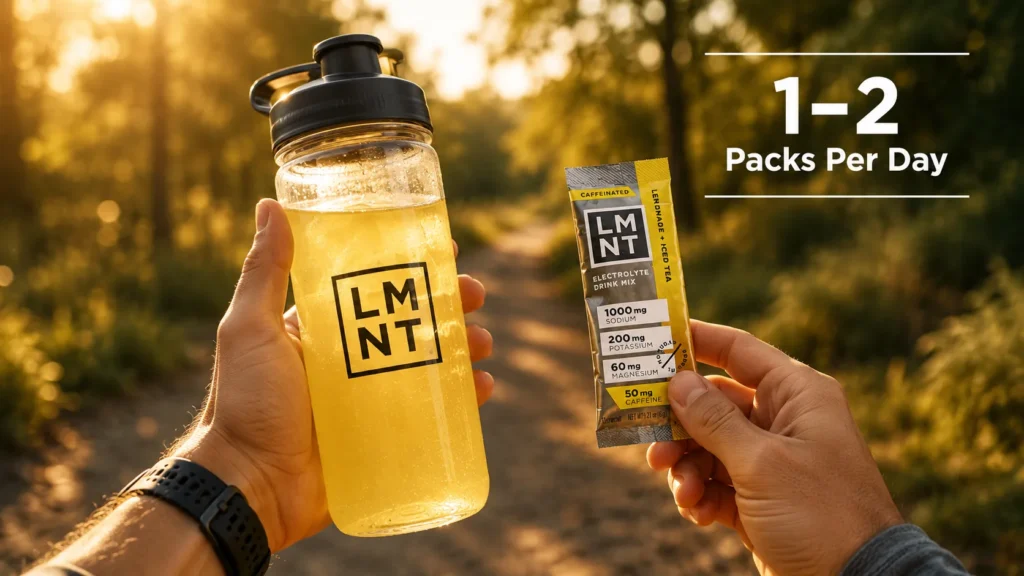
Knowing how much sodium in LMNT per packet naturally leads to the question of daily limits. LMNT’s own FAQ states that the answer depends heavily on the individual – which is actually the most honest answer.
Their science-backed daily targets are:
- Sodium: 4–6 grams per day
- Potassium: 3.5–5 grams per day
- Magnesium: 400–600 mg per day
At 1,000 mg sodium per packet, one LMNT packet covers 17–25% of their sodium target. Two packets would cover 33–50%. Most people find 1–2 packets per day optimal, which is exactly what LMNT recommends as the starting range – with Virta Health, which integrates LMNT into its ketogenic clinical protocol, suggesting spacing packets roughly 8 hours apart for best absorption throughout the day.
For people dealing with nighttime muscle cramps despite adequate water intake, the mineral gap – particularly magnesium and sodium – is almost always the real culprit. Our guide on the best electrolytes for leg cramps at night connects this directly and explains what to supplement and when.
Who Should Be Cautious About LMNT’s Sodium Content?
LMNT isn’t for everyone – and the brand acknowledges this directly. Certain groups need to approach the 1,000 mg per packet with genuine care:
People with High Blood Pressure
The AHA recommends 1,500 mg of sodium per day for people managing hypertension. One LMNT packet covers 67% of that limit. Daily LMNT use without medical clearance isn’t appropriate for sodium-sensitive individuals.
People with Kidney Disease
Healthy kidneys regulate sodium excretion efficiently. Compromised kidneys can’t do this as effectively. People managing chronic kidney disease should consult a nephrologist before adding 1,000 mg of sodium per packet to their routine.
Sedentary People on Processed Food Diets
If you sit most of the day and eat typical restaurant or packaged food – which already carries significant sodium – adding an LMNT packet pushes total daily sodium significantly beyond what an inactive lifestyle requires. The math simply doesn’t work in favor of daily LMNT use for this group.
LMNT Flavors, Third-Party Testing, and Formula Consistency
One detail worth noting: how much potassium in LMNT stays consistent across all flavors. Whether you’re drinking Citrus Salt, Watermelon Salt, Mango Chili, Chocolate Salt, or the Raw Unflavored version – the core formula never changes. Every packet delivers exactly 1,000 mg sodium, 200 mg potassium, and 60 mg magnesium, with the only variation being the flavoring agents and calorie count (0 calories in Raw Unflavored vs 5–10 in flavored versions).
LMNT is also third-party tested for heavy metals, pathogens, and mineral content accuracy, which registered dietitian reviews confirm. According to Barbend’s 2026 review, this independent testing adds genuine credibility to the label claims – so the numbers you see on the packaging actually reflect what’s in the product.
The current flavor lineup includes Citrus Salt, Watermelon Salt, Raspberry Salt, Grapefruit Salt, Orange Salt, Lemon Habanero Salt, Mango Chili Salt, Chocolate Salt, Chocolate Caramel Salt, and Raw Unflavored. All of them use the same LMNT Zero Sugar Electrolytes formula. The flavored options use stevia and natural flavors. None contain artificial sweeteners, artificial colors, or preservatives.
Final Verdict: Is the Sodium Level in LMNT Worth It?
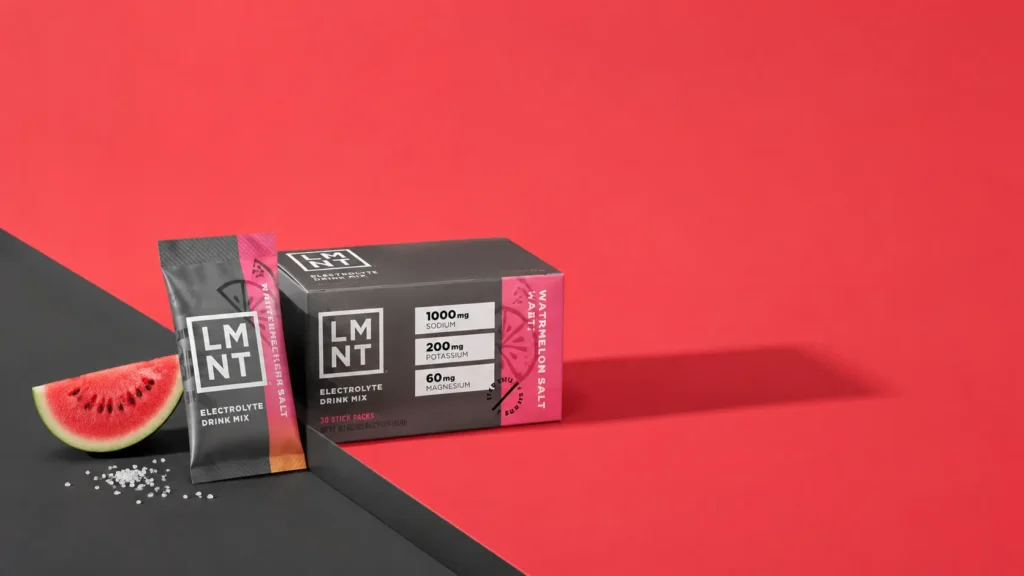
How much sodium in LMNT – 1,000 mg per packet – is the highest of any mainstream electrolyte product on the market. That’s intentional. For active individuals, keto and low-carb dieters, endurance athletes, and people in hot climates who lose significant sodium through sweat, this level directly addresses a genuine physiological gap.
The formula backing – LMNT Zero Sugar Electrolytes with 1,000 mg sodium, 200 mg potassium, and 60 mg magnesium – reflects real coaching data and peer-reviewed research, including the 2011 JAMA study that put the optimal daily sodium target at 4–6 grams. One packet contributes one-quarter of that range. Two packets per day keeps most active people comfortably within it.
The type of sodium – sodium chloride – is the most direct electrolyte replacement form, matching what sweat actually depletes. What kind of sodium is in LMNT matters practically because chloride-based sodium absorbs efficiently and supports the nerve and muscle functions that athletes and active people depend on.
And how much potassium in LMNT – 200 mg – is calibrated to the 5:1 sodium-to-potassium ratio of the body’s cellular pump mechanism, not chosen arbitrarily. The whole formula holds together when you understand the physiology behind each number. For the right person, that formula works exactly as designed.
Frequently Asked Questions (FAQ)
Here are the most commonly asked questions about LMNT’s sodium content – answered directly.
Q1. How much sodium in LMNT per packet?
How much sodium in LMNT per packet is exactly 1,000 mg – equivalent to 1 gram. This represents 43% of the FDA’s recommended daily value of 2,300 mg. It’s the highest sodium content of any mainstream electrolyte product, and it’s designed specifically for active people, keto dieters, and heavy sweaters.
Q2. What kind of sodium is in LMNT?
What kind of sodium is in LMNT is sodium chloride – the same compound as table salt. This is listed as “Salt (Sodium Chloride)” on the ingredient panel. LMNT also contains potassium chloride, which contributes chloride as a secondary mineral. Sodium chloride is the most bioavailable and direct form of electrolyte sodium, matching what the body loses through sweat.
Q3. How much potassium in LMNT?
How much potassium in LMNT per packet is 200 mg – sourced from potassium chloride. This equals 4% of the FDA daily value. The 5:1 sodium-to-potassium ratio is intentional, designed to complement the sodium-potassium pump in every cell membrane, which moves three sodium ions out for every two potassium ions it takes in.
Q4. Is LMNT really zero sugar?
Yes. LMNT Zero Sugar Electrolytes contains 0 grams of sugar across every flavor in the lineup. Flavored versions use stevia leaf extract as a sweetener. The Raw Unflavored version contains no sweeteners at all. There is no glucose, dextrose, sucrose, or fructose in any LMNT product.
Q5. Is 1,000 mg of sodium per packet too much?
For healthy, active adults – especially those on keto, whole-foods, or paleo diets – 1,000 mg per packet is not too much. LMNT’s science team targets 4–6 grams of daily sodium based on a 2011 JAMA study, meaning one packet covers only 17–25% of that target. However, for people with high blood pressure, kidney disease, or sedentary lifestyles already consuming sodium-heavy processed food, 1,000 mg per packet warrants caution and medical guidance.
This article contains affiliate links. If you purchase through our links, we may earn a commission at no extra cost to you. We only recommend products we genuinely believe in. Read our Affiliate Disclaimer for full details.