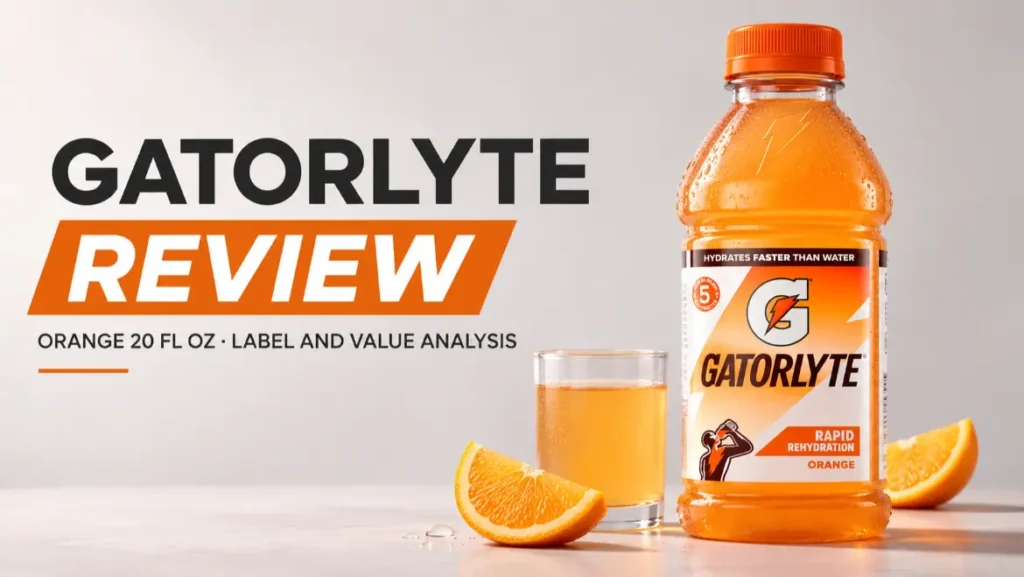
This Gatorlyte review finds that the Orange 20 fl oz bottle is a convenient, sodium-forward drink for heavy sweating, hot conditions, and longer exercise. Its current label lists five electrolytes, including 500 mg sodium, plus 12 g added sugar. It is more targeted than ordinary flavored water, but unnecessary for many short or easy workouts.
Table of Contents
Gatorlyte sits between classic sports drinks and specialized electrolyte formulas. It offers more sodium and a broader mineral profile than standard Gatorade, while using less sugar than many traditional sports drinks. That makes it useful for certain situations, but not automatically the best everyday beverage. This Gatorlyte review weighs that specific tradeoff throughout.
This Gatorlyte review focuses only on Gatorlyte Rapid Rehydration Orange in the 20 fl oz ready-to-drink bottle. Gatorlyte powder and Gatorlyte Zero are separate formulas with different nutrition facts, so their numbers should not be applied to this bottle.
Gatorlyte Review at a Glance
| Feature | Gatorlyte Rapid Rehydration Orange |
| Format | Ready-to-drink bottle |
| Serving size | 1 bottle, 20 fl oz (591 mL) |
| Calories | 50 |
| Sodium | 500 mg on the current embedded label |
| Potassium | 350 mg |
| Magnesium | 105 mg |
| Calcium | 120 mg |
| Chloride | 1,040 mg |
| Total and added sugar | 12 g |
| Sweeteners | Sugar and purified stevia leaf extract |
| Caffeine | None listed |
| Best fit | Heavy sweating, heat, longer training, convenient recovery |
The short verdict from this Gatorlyte review is that the product delivers a substantial electrolyte dose in a familiar bottled format. Its main compromises are 12 g added sugar, a relatively high sodium contribution for casual use, and Yellow 6 in the Orange formula.
What Is Gatorlyte?
Gatorlyte is Gatorade’s electrolyte-focused rapid rehydration line. The official Gatorlyte Orange product page positions the drink for on-the-go hydration before, during, or after exercise and highlights its blend of sodium, potassium, magnesium, chloride, and calcium. For accuracy, this Gatorlyte review evaluates only that ready-to-drink Orange formula.
The ready-to-drink bottle removes the preparation step required by powders. You can chill it, open it, and drink it without finding clean water or measuring a packet. That convenience is one of the strongest practical advantages identified in this Gatorlyte review.
Gatorlyte is not simply regular Gatorade with a different label. Gatorade Thirst Quencher emphasizes carbohydrate fuel alongside sodium and potassium. Gatorlyte uses a lower-carbohydrate approach and includes three additional listed electrolytes: magnesium, calcium, and chloride.
Gatorlyte Nutrition Facts and Electrolytes

The current embedded Nutrition Facts panel for Orange lists one 20 fl oz bottle as a single serving. It provides 50 calories, 12 g carbohydrate, 12 g total sugar, and 12 g added sugar. There is no fat or protein. Those current values form the nutrition baseline for this Gatorlyte review.
The electrolyte profile includes 500 mg sodium, 350 mg potassium, 105 mg magnesium, 120 mg calcium, and 1,040 mg chloride. Those numbers make the bottle considerably more mineral-focused than a lightly enhanced water.
There is one detail shoppers should understand. Gatorade’s product copy and FAQ still state 490 mg sodium, while its newer embedded Nutrition Facts panel, updated October 31, 2026, shows 500 mg. This Gatorlyte review uses the newer label figure, but the package in your hand remains the final reference because product information can change.
Sodium
Sodium is the main electrolyte lost in sweat, and Gatorlyte supplies a meaningful amount. The current 500 mg figure equals about 22% of the FDA Daily Value. The FDA Nutrition Facts guidance treats 20% Daily Value or more per serving as high.
That does not make the amount inherently good or bad. A heavy or salty sweater training in heat may have a reason to replace substantial sodium. Someone sitting at a desk, eating a sodium-rich diet, or following a clinician-directed sodium restriction has a very different context.
Readers deliberately seeking gentler formulas can compare the options in our lower-sodium electrolyte drinks guide. The useful product is the one that matches actual losses and dietary needs, not necessarily the one with the largest number.
Potassium, Magnesium, Calcium, and Chloride
Gatorlyte’s broader mineral profile is what most clearly separates it from ordinary Gatorade. One bottle lists 350 mg potassium, 105 mg magnesium, 120 mg calcium, and 1,040 mg chloride.
Potassium and sodium help regulate fluid balance and support nerve and muscle function. Magnesium and calcium also participate in normal muscle and nerve activity. Chloride commonly accompanies sodium and contributes to fluid and acid-base balance.
The presence of five electrolytes sounds impressive, but the count alone does not prove the drink is superior for every person. Dose, fluid volume, exercise conditions, food intake, medical history, and tolerance matter more than the length of the mineral list.
Sugar, Carbohydrate, and Calories
Gatorlyte Orange contains 12 g added sugar and 50 calories per bottle. The product is lower in sugar than many conventional sports drinks, but “lower sugar” does not mean sugar-free. One bottle contributes 24% of the 50 g FDA Daily Value for added sugars.
Carbohydrate can support fluid absorption and provide some energy during prolonged activity. However, 12 g may be unnecessary for someone who wants only flavor during a short walk or an easy gym session. Gatorlyte Zero is a separate option for shoppers prioritizing zero sugar, but it should be reviewed using its own label.
This Gatorlyte review therefore treats sugar as a tradeoff rather than an automatic defect. The amount may be useful during demanding activity and less attractive for routine sipping.
Gatorlyte Ingredients Explained
The current Orange ingredient list is: water, sugar, citric acid, salt, calcium lactate, potassium chloride, magnesium oxide, gum arabic, purified stevia leaf extract, natural flavor, sucrose acetate isobutyrate, glycerol ester of rosin, and Yellow 6. A complete Gatorlyte review needs to assess that whole list, not only the five electrolytes advertised on the front.
Salt supplies sodium and chloride, while calcium lactate, potassium chloride, and magnesium oxide provide the other named minerals. Citric acid creates tartness. Gum arabic and the beverage stabilizers help keep flavor and color dispersed throughout the bottle.
Gatorade states that Gatorlyte has no artificial sweeteners or flavors. The formula does use purified stevia leaf extract, a high-intensity plant-derived sweetener, alongside sugar. It is therefore not artificially sweetened according to the brand, but it is also not unsweetened.
Orange Gatorlyte contains Yellow 6. That is an artificial color, even though the product page says there are no artificial sweeteners or flavors. Shoppers avoiding artificial colors should not assume those statements cover color additives.
How Does Gatorlyte Compare With Regular Gatorade?
The practical difference is concentration and purpose. Regular Gatorade Thirst Quencher is built as a sports drink that supplies fluid, sodium, potassium, and carbohydrate fuel. Gatorlyte is more electrolyte-forward, provides five listed electrolytes, and contains less sugar than the leading sports drink comparison used by Gatorade. That distinction is central to this Gatorlyte review.
The 20 oz Gatorlyte bottle lists 500 mg sodium and 350 mg potassium on its current label. That is a more substantial mineral contribution than standard Gatorade Thirst Quencher in the same general bottle size. In return, the Orange bottle has a more specialized taste and may feel excessive for light daily activity.
Our Gatorlyte vs Liquid IV comparison examines how this ready-to-drink formula compares with a popular powder stick. Format can be just as important as nutrition: a bottle is immediately convenient, while powder is lighter to store and travel with.
Taste and Flavor Options
This Gatorlyte review does not claim a firsthand taste test. Based on the ingredients and product positioning, Orange should be expected to taste sweet, citrusy, and somewhat mineral-forward rather than like plain flavored water. Sugar, stevia, citric acid, salt, and orange flavor all shape the result.
The current ready-to-drink lineup includes Orange, Cherry Lime, Glacier Freeze, Lime Cucumber, Mixed Berry, Strawberry Kiwi, and Watermelon. Availability varies by retailer and package size.
People sensitive to stevia may notice its lingering sweetness. Others may find the combination easier to drink than a very salty electrolyte powder. Taste is personal, so purchasing one bottle before committing to a multipack is the sensible approach.
Who Is Gatorlyte Best For?

This Gatorlyte review finds the strongest fit among people dealing with heavy sweating, hot-weather activity, longer training sessions, outdoor work, or a need for a convenient post-exercise drink. The ready-to-drink bottle is especially useful when carrying and mixing powder would be inconvenient.
The American College of Sports Medicine notes that most people exercising for less than 60 to 90 minutes in normal weather are unlikely to become significantly dehydrated or electrolyte-depleted. Its hydration and electrolyte guidance places greater emphasis on endurance athletes, hot-weather competitors, outdoor workers, and people who sweat heavily.
For travel, Gatorlyte’s bottle is convenient after security or during a road trip, but powder packets are much easier to pack before a flight. Our best electrolyte packets for travel and long flights guide compares lighter alternatives designed for luggage.
Gatorlyte may be a poor fit for people following a low-sodium plan, avoiding added sugar, avoiding Yellow 6, or simply completing brief low-intensity activity. Kidney disease, heart disease, fluid restrictions, and medications that affect electrolytes are reasons to seek individualized medical advice.
How and When to Drink Gatorlyte
Gatorlyte Orange is already mixed. Chill if preferred, shake gently if the label directs, open the bottle, and drink according to thirst and the demands of the activity. There is no need to add water unless you personally want a lighter flavor. This Gatorlyte review assumes the product is consumed at its bottled concentration.
The most logical timing is before, during, or after an occasion involving meaningful sweat loss. Drinking the entire bottle automatically after every short workout may add sodium and sugar you did not need. A better approach is to consider session length, temperature, sweat rate, food intake, and how you feel.
Gatorlyte should not be treated as a substitute for medical evaluation when someone has severe dehydration, confusion, fainting, persistent vomiting, bloody diarrhea, or an inability to keep fluids down. A commercial sports hydration drink is not automatically equivalent to a clinical oral rehydration solution.
Price, Availability, and Value
Gatorlyte is widely sold through grocery stores, convenience stores, mass retailers, and online marketplaces. It is available as individual 20 oz bottles and in multipacks, but price varies substantially by seller, location, delivery fees, and promotion. A dependable Gatorlyte review therefore evaluates cost per bottle rather than relying on one temporary sale price.
Value depends on use frequency. A single chilled bottle can be worth the premium when you need immediate convenience. Regular daily use is more expensive and produces more packaging waste than mixing powder in a reusable bottle.
Before setting up recurring delivery, compare the unit price per bottle and confirm which flavor and formula are included. If a recurring order no longer suits your needs, our Gatorlyte subscription cancellation guide explains how management differs between Gatorade and third-party retailers.
This Gatorlyte review does not assign a fixed price because no single official checkout price applies across every retailer. Current cost per bottle is more useful than a stale promotional figure.
Gatorlyte Review Pros and Cons

Pros
• Five-electrolyte blend: Sodium, potassium, magnesium, calcium, and chloride are all listed.
• Ready-to-drink convenience: No packet, measuring, or mixing is required.
• Meaningful sodium level: The drink may better match heavy sweat losses than lightly mineralized water.
• Lower sugar than many conventional sports drinks: The bottle contains 12 g rather than the much larger amount found in some traditional formulas.
• Multiple flavors: Seven ready-to-drink choices are currently shown on the official product page.
• Widely available: Bottles are commonly sold in mainstream retail channels.
Cons
• High sodium for casual use: The current 500 mg label figure equals about 22% Daily Value.
• Contains 12 g added sugar: It will not suit zero-sugar goals.
• Uses stevia: Some people dislike its aftertaste even though it is plant-derived.
• Contains Yellow 6: Orange is not free from artificial coloring.
• Bottle format costs more to ship and store: Powder is usually more portable and creates less packaging per serving.
• Official sodium figures conflict slightly: Current label data show 500 mg, while other official copy still states 490 mg.
The balance in this Gatorlyte review is favorable when a concentrated, ready-to-drink formula matches the situation. It is less persuasive as an automatic everyday beverage.
Is Gatorlyte Worth It?
Gatorlyte is worth considering if you regularly sweat heavily, train in hot conditions, work outdoors, or want a convenient bottle with more electrolytes than classic sports drinks. The five-electrolyte formula and substantial sodium level give the product a clear purpose.
It offers less value when water and normal meals already cover your needs. A lightly active person may be paying for sodium, sugar, and specialized positioning without receiving a meaningful practical benefit.
The fairest conclusion from this Gatorlyte review is that it is a targeted tool, not a universal upgrade over water. Buy it for a defined hydration occasion rather than because the label sounds more advanced.
Gatorlyte Review FAQs
How much sodium is in Gatorlyte?
The newest embedded Nutrition Facts panel for Gatorlyte Orange lists 500 mg sodium per 20 oz bottle. Some official page copy still states 490 mg. Check the bottle you purchase because packaging and formulas may change.
Does Gatorlyte contain sugar?
Yes. Orange contains 12 g total sugar, all listed as added sugar. It also uses purified stevia leaf extract. Gatorlyte Zero is a separate zero-sugar product.
What electrolytes are in Gatorlyte?
Gatorlyte lists sodium, potassium, magnesium, calcium, and chloride. The current Orange label shows 500 mg sodium, 350 mg potassium, 105 mg magnesium, 120 mg calcium, and 1,040 mg chloride.
Is Gatorlyte better than regular Gatorade?
It depends on the purpose. Gatorlyte provides a broader and more concentrated electrolyte profile with less sugar than many traditional sports drinks. Regular Gatorade may better fit athletes who want more carbohydrate fuel during activity.
Can you drink Gatorlyte every day?
Many healthy adults can consume it, but daily use is not necessary for everyone. Consider total dietary sodium, added sugar, activity, climate, medications, and medical conditions before making it routine.
Is Gatorlyte good for short workouts?
It may be unnecessary for a short, easy workout in moderate weather. Water and normal meals are often sufficient. The drink becomes more relevant as sweat loss, heat, duration, or intensity increases.
Is Gatorlyte an oral rehydration solution?
Gatorlyte is marketed as a rapid rehydration sports beverage, not as a universal replacement for clinical oral rehydration therapy. Significant illness-related dehydration requires appropriate medical guidance.
Does Gatorlyte contain artificial sweeteners?
The brand says it contains no artificial sweeteners or flavors. Orange uses sugar and purified stevia leaf extract, but it does contain the artificial color Yellow 6.
Final Gatorlyte Review Verdict
The final Gatorlyte review verdict is positive for demanding hydration situations and mixed for casual daily use. Gatorlyte Rapid Rehydration Orange supplies five electrolytes, including a meaningful sodium dose, in a convenient 20 oz bottle. Its lower-sugar positioning also gives it a clearer purpose than many conventional sports drinks.
The drawbacks matter. The current label lists 500 mg sodium, 12 g added sugar, stevia, and Yellow 6. Those features will exclude shoppers seeking low sodium, zero sugar, no stevia, or no artificial color.
Choose Gatorlyte when heat, heavy sweating, longer training, or convenience justifies its concentrated formula. Choose water or a lighter electrolyte product for ordinary low-intensity hydration. That context-based decision is more useful than calling any sports drink the best option for everyone.
This article contains affiliate links. If you purchase through our links, we may earn a commission at no extra cost to you. We only recommend products we genuinely believe in. Read our Affiliate Disclaimer for full details.